Skip to product information
1 of 2

Ping Sonar Altimeter and Echosounder

Ping Sonar Altimeter and Echosounder

Ocean Robotix Pvt Ltd

Accessories and Add-Ons

100 in stock

The Ping Sonar is a single beam echosounder that measures distances up to 100 meters underwater. A 25 degree beam width, 300 meter depth rating, and an open-source software interface make it a powerful tool for marine robotics. Can connect directly to the Navigator Flight Controller. For USB connections, we recommend connecting with the BLUART USB to Serial and RS485 Adapter!

Buy More, Save More!
Quantity
Regular price Rs. 45,150.00
Regular price Sale price Rs. 45,150.00
Sale Sold out
SKU: BR-101684
  • Free Shipping Globally
  • Try it Risk-Free for 90 Days
  • FDA Cleared
View full details

Product Description

The Ping Sonar is a multipurpose single beam echosounder. It can be used as an altimeter for ROVs and AUVs, for bathymetry work aboard a USV, obstacle avoidance on autonomous vehicles, and other underwater distance measurement applications. The Ping Sonar combines a compact form factor and 300 meter depth rating with an open-source software to create a powerful new tool for marine robotics!
What is a Single Beam Echosounder?
An echosounder, like the Ping Sonar, is one of the simplest forms of underwater sonar. It operates by using a piezoelectric transducer to send an ultrasonic acoustic pulse into the water and then listens back for echoes to return. With that information, it can determine the distance to the strongest echo, which is usually the ocean floor or a large object. It can also provide the full echo response (echo strength versus time) which can be plotted like the display of a fishfinder sonar.

Designed for the Depths
The Ping Sonar uses a 115 kHz transducer frequency, away from those used on most boat echosounders to avoid interference. It has a measurement range of 100 meters (328 feet) and a measurement beamwidth of 25 degrees, perfect for applications on a rocking boat or for obstacle avoidance. An advanced bottom-tracking algorithm runs on the device to determine the distance to the seafloor, even in complicated situations with multiple echoes.

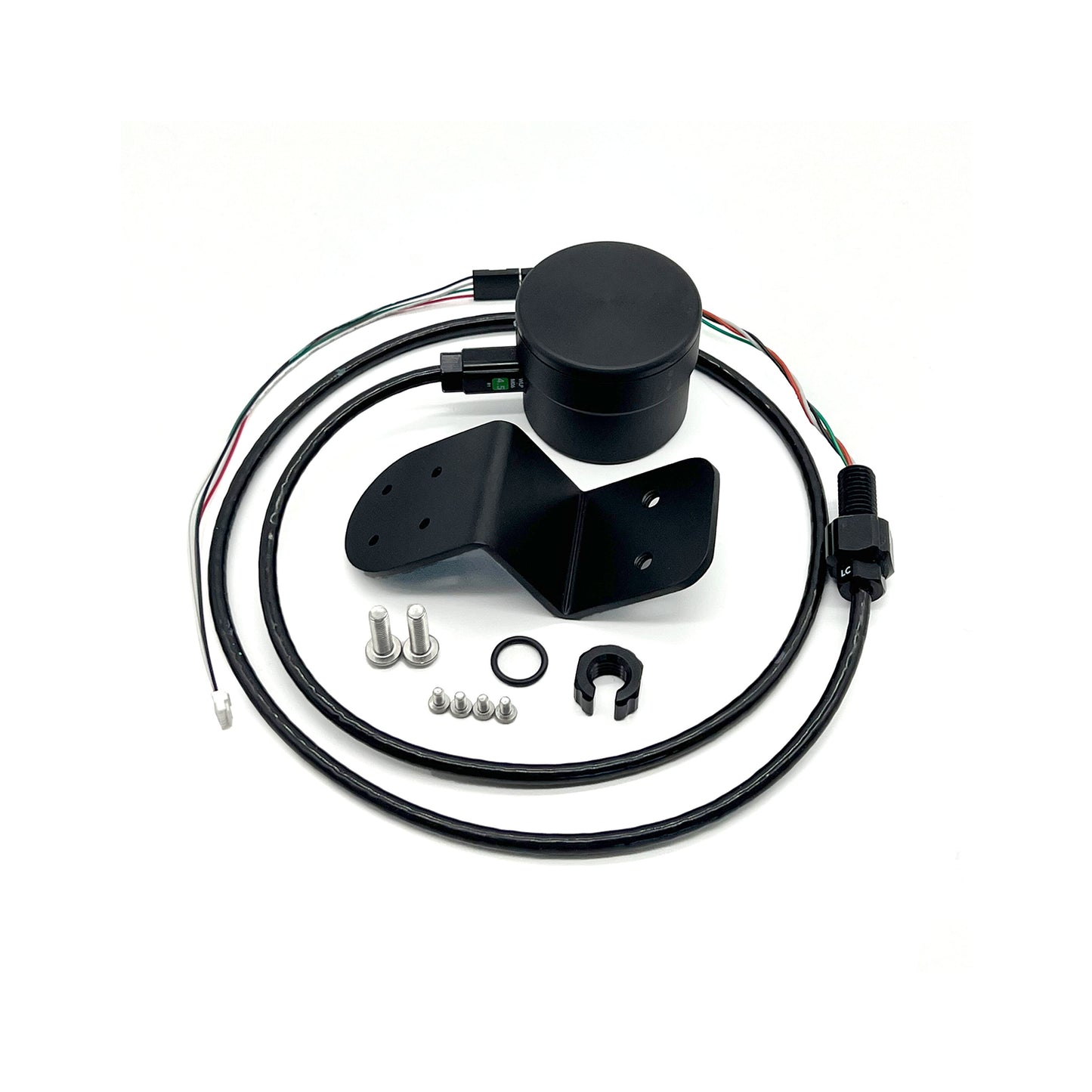
The Ping Sonar is housed in a rugged hard-anodized aluminum enclosure with a 1 meter (3.3 feet) cable and a pre-installed WetLink Penetrator. It has four threaded mounting holes and comes with a mounting bracket and hardware for easy installation on the BlueROV2. The included header pin to JST GH adapter makes it easy to plug into the USB to Serial and RS485 Adapter.

Using the Ping
The Ping can be connected to a microcontroller device, such as an Arduino, or to a computer through a BLUART USB to Serial adapter.

Once connected, we recommend getting started with Ping Viewer, an open-source application developed specifically for Ping devices. Ping Viewer makes it easy to view the output, record data, and change settings on the Ping and runs on Windows, Mac, and Linux. The Ping Sonar can be connected to Ping Viewer directly or over a network connection routed through BlueOS, so that you can use the Ping on the ROV without using any additional wires in the tether.

For those who wish to integrate the Ping Sonar into other systems, it communicates with a binary message format called Ping Protocol. We’ve made C++, Arduino, and Python development libraries for Ping Protocol to get you up and running almost immediately.

  • 1 x Ping Sonar
  • 1 x Ping Sonar mounting bracket (BR-100123)
  • 1 x 4 position female header to 6 position JST GH cable adapter (BR-100112)
  • 4 x M3x5 button head cap screws (BR-100689)
  • 2 x M5x16 button head cap screws (BR-101091)
  • 1 x M10 bulkhead O-ring
  • 1 x M10 bulkhead nut (BR-100338)
Parameter Value
Electrical
Supply Voltage 4.5–5.5 V
Logic Level Voltage 3.3 V (5 V tolerant)
Transducer Drive Voltage 27 V
Current Draw 100 mA (typical)
900 mA (peak)
Communication
Signal Protocol TTL Serial (UART)
Available Firmware Baud Rates 115200 bps (default)
9600 bps
Message Protocol Ping Protocol
Message Subsets common_ping1d
Software Development Libraries
Supported Libraries Arduino
ArduPilot (limited)
C++
Python
Rust
Custom firmware
Cable
Cable Used BR-100452
Cable Length 875 mm
34.5 in
Maximum Cable Length 8 m
26 ft
Conductor Gauge 24 AWG
Wires Black – Ground
Red – Vin
White – TX (out)
Green – RX (in)
Installed Penetrators
Device Side M06-4.5mm-LC
Cable End M10-4.5mm-LC
Acoustics
Frequency 115 kHz
Source Level 198 dB re 1 µPa @ 1 m
Beamwidth (-3 dB from peak) 25 degrees
Typical Minimum Range 0.3 m
1 ft
Typical Usable Range1 100 m
328 ft
Range Resolution 0.5% of range
Range Resolution at 100 m (waterfall range, not measured range) 50 cm
19.7 in
Range Resolution at 2 m (waterfall range, not measured range) 1 cm
0.4 in
Physical
Depth Rating 300 m
984 ft
Temperature Range 0–30°C
32–86°F
Weight in Air (w/ cable) 187 g
0.41 lb
Weight in Water (w/ cable) 100 g
0.22 lb
Mounting Bracket Screw Size M5×16 mm
Internals
Air Chamber O-Ring AS568-030, Buna-N, 70A
1Usable range depends on operating conditions (e.g. performance may suffer over variable density changes from tall vegetation, groups of fish, geysers, etc).

Connecting Ping To a Computer
1. Download Ping Viewer for your operating system.
2. Plug the male header pins from the Ping sonar cable into the female header to JST GH cable adapter. Match the colors of all the wires, red to red, black to black, green to green, and white to white.
3. Plug the 6-position JST GH plug into the serial JST GH receptacle on the BLUART adapter.
4. Plug the BLUART into the computer using a Micro-USB to USB-A Cable.
5. Start Ping Viewer, it should automatically detect the connected Ping Sonar and display it in the device manager menu.
6. Select the Ping from the device manager menu and the waterfall display should automatically start. If there are issues with establishing a connection, please check our Ping Viewer troubleshooting steps.

4 May 2023

  • BR-101684 RevB – Initial release
    Updated Ping Sonar to pottingless design
    Changed to narrower, 25° beamwidth
    Increased typical usable range to 100 meters
    Larger external dimensions
    Ping mounting bracket updated to fit larger Ping diameter


13 April 2023

  • Bulkhead O-ring color changed to blue

4 October 2021

  • R3 – Initial release
    Updated pre-installed penetrators to WetLink Penetrators

23 July 2021

  • Typical usable range value extended from 30m to 50m based on follow-on usage and variability testing

29 January 2019

  • R2 – Initial release